Tuesday, 9 January 2018
The owl is calling
It is a still, cold night.
From outside, there is a calling, a beckoning. It sounds human and causes me to pause.
It is puzzling.
Then I know. It is the hoot of an owl, filtering into the house, louder than the crackling fire.
I turn off the lights, creep to the window, then open the front door.
The owl is not far away, maybe in the walnut tree twenty metres from the house, maybe further.
His triumphant call echoes down the river, piercing the silence of the night. It moves over the water across the flickering shafts of light, reflected from the town on the opposite bank.
The sound is haunting. Is he or she calling for or to a mate? I don't know. Its evocative cry brings Cliona from her bed.
We listen transfixed.
I know, in the darkness, his penetrating eyes see all.

Saturday, 6 January 2018
Morocco ... part five
In 1982, as an academic requirement for my journalism degree, I wrote an article about Marrakech.
In it, I described the excitement of Jmaa El Fna, the famous square whose name reflects the past horrors of a cruel Sultan.
In more recent centuries, it evokes the romance of one of the world's most intriguing locations.
I got a good mark for that assignment, as my memory of the place was fresh from my time in Morocco.
Now, almost 40 years on, the same scenes unfolded before my daughter and me as we stood below the Cafe de France and took in the whirling, pulsating kaleidoscope.
But the enchantment was short-lived, as a procession of botherers, beggars and bling salesmen distracted us with their entreaties.
Tourism is, of course, the lifeblood of Marrakech, but it has corrupted the exoticism of the place.
For hundreds of years, camel caravans from Timbuktu manifested dream-like out of the desert and found their caravanserai within the walls of the city.
In Jmaa el Fna, travellers and merchants were entertained by dervish dancers, snake charmers, monkey-handlers, musicians, drummers and story-tellers.
After nightfall, they ate from bbq stalls around the perimeter of the square. Here, mouth-watering smells wafted from lamb brochettes on charcoal, fanned by half-lit figures in hooded djellabas.
These days it is tourists who stream in from all parts of the world, but the entertainment seems staged and purely commercial. On the fringes of the square, look-outs scan the crowd for those who dare raise their cameras without paying a fee.
They tell me the tourist trap that was Marrakech got so bad the King decreed "Enough!" and tourist police were installed in and around the square to curb excesses.
Jmaa el Fna is a sensory overload, but the show now seems all rather routine, which is a pity.
 |
| Djmaa el Fna street level |
 |
| the bbq stalls herald nightfall |
Wednesday, 3 January 2018
Morocco ... part four
Marrakech ... one of the most exotic locations in Africa.
Driving through the outskirts, with pink-stucco suburbs set amongst the soft green palms, the anticipation is strong, but the reality, when it hits, is stronger.
The medina's dusty, teeming streets are flooded with a tsunami of images and sound ... the amplified guttural calls to prayer, the crushing mass of people, the fetid nooks of rotting rubbish, the djellaba-hooded beggars squatting against stone walls, their dirty rags holding a few dirty coins ... scenes that could be from a thousand years ago, or a thousand and one nights.
This is the life of the people, the poor people, the haggling, hustling, hand to mouth existence that has not changed since the reign of sultans and the succession of post-colonial kings.
The veggie stalls, the butchers, the olive sellers, fruit carts, bread and pastry shops, the sellers of snails, the spice merchants, the purveyors of scented herbs, the hawkers of cheap women's clothes, the dimly lit restaurants and smoky kebab stalls, the cool Arabian riads off darkish alleyways, the hot tubs of hidden bathhouses. Movement, always movement, like blood through veins ... people, donkey carts, manic mopeds, horn-sounding cars creeping like lizards over the cobblestones through an unyielding crowd.
It is intoxicating without grog, stupefying without hash. It takes my breath away, just like it did 40 years ago.
Driving through the outskirts, with pink-stucco suburbs set amongst the soft green palms, the anticipation is strong, but the reality, when it hits, is stronger.
The medina's dusty, teeming streets are flooded with a tsunami of images and sound ... the amplified guttural calls to prayer, the crushing mass of people, the fetid nooks of rotting rubbish, the djellaba-hooded beggars squatting against stone walls, their dirty rags holding a few dirty coins ... scenes that could be from a thousand years ago, or a thousand and one nights.
This is the life of the people, the poor people, the haggling, hustling, hand to mouth existence that has not changed since the reign of sultans and the succession of post-colonial kings.
The veggie stalls, the butchers, the olive sellers, fruit carts, bread and pastry shops, the sellers of snails, the spice merchants, the purveyors of scented herbs, the hawkers of cheap women's clothes, the dimly lit restaurants and smoky kebab stalls, the cool Arabian riads off darkish alleyways, the hot tubs of hidden bathhouses. Movement, always movement, like blood through veins ... people, donkey carts, manic mopeds, horn-sounding cars creeping like lizards over the cobblestones through an unyielding crowd.
It is intoxicating without grog, stupefying without hash. It takes my breath away, just like it did 40 years ago.
 |
| cool riads off shadowy alleys |
 |
| secret places lie beyond ancient archways |
 |
| olive stall |
 |
| pink stucco and green palms |
 |
| street market in the medina |
Sunday, 31 December 2017
Morocco ...part three
Jamilla and I hired a car in Casablanca and drove to Marrakech, passing at speed through lunar landscapes made earthly by lines of dead cactus and mud villages almost invisible against the baked-brown hillsides.

Arriving in the fabled pink city, we left the car in a dusty carpark on the edge of the medina, at Bab Aylen.
We followed Didier, our Airbnb host, under a medieval stone archway and into the thronging, noisey thoroughfare, the tall, grey-haired Frenchman flicking the occasional "Salaam Alicum" to Arab acquaintances he passed.
 |
| The entrance to the riad |
Deep in the popular quarter, a series of cobbled alleyways led to Didier's riad. Its unprepossessing entrance belied a pleasant, courtyard home into which you descended through a cast-iron security door.
Inside, a bougainvillea climbed towards the light and was alive with tiny, chattering birds. Although Didier's heart was in Marrakech, a cluster of fascinating artefacts betrayed his Madagascar dreaming.
 |
| Didier's riad |
 |
| the archway leading to Didier's Marrakech riad |
Thursday, 28 December 2017
Morocco ... Part two
Before we left Casablanca for Marrakech, I wanted to visit some of my old haunts from 40 years ago.
Jamilla and I went to rond point (roundabout) Mers Sultan, a chaotic merging of seven, wheel-spoke lanes in a residential suburb not too far from the city. I used to live in a first floor flat near here. I thought I'd found my old flat, or at least the street-level entrance to it, but I could not be sure after so many years.
During long balmy evenings I used to lounge around on the terrace above the street din with my friends Ahmed and Abdulhak, smoking and listening to "Can't Buy a Thrill".
Ahmed is dead. Abdulhak is an Imam in Italy, or so I've heard. Nothing lasts. Nothing stays the same. Experiences fade to memory. Once familiar landmarks become a palimpsest.
So now, I wanted to sit outside Cafe Mers Sultan, on the rond point, and drink a beer or a coffee, just like I did almost every day in '78. But the cafe's licence had long changed, forbidding the consumption of alcohol al fresco.
I walked to Brasserie du Soleil, fully expecting it to be gone ... but it was still there. This is where I ate dinner most nights, at a footpath table. It's still called Brasserie du Soleil but has become a dark and dingy beer bar, windows papered up, as if it should be ashamed of itself.
Nothing stays the same.
Wednesday, 27 December 2017
Morocco ... Part One
It's been thirty-two years since I was last in Morocco, a long time between mint teas.
I took my daughter there to celebrate her 26th birthday.
Our sojourn began with a one hour wait at Casablanca airport's passport control.
Despite the long queue behind us, the immigration officer was happy to spend some relaxed time querying Jamilla's origins.
"You've got an Arabic name?" he asked.
"Yes," she said.
"But you are Australian?"
"Yes."
"Is your mother or father Moroccan?" he asked.
"Yes, my mother," she said.
It was late at night and we got one of the last trains from the airport to the port, then paid an exorbitant fare for a devious taxi driver to take us through near-empty streets to our hotel in the old city.

I took my daughter there to celebrate her 26th birthday.
Our sojourn began with a one hour wait at Casablanca airport's passport control.
Despite the long queue behind us, the immigration officer was happy to spend some relaxed time querying Jamilla's origins.
"You've got an Arabic name?" he asked.
"Yes," she said.
"But you are Australian?"
"Yes."
"Is your mother or father Moroccan?" he asked.
"Yes, my mother," she said.
It was late at night and we got one of the last trains from the airport to the port, then paid an exorbitant fare for a devious taxi driver to take us through near-empty streets to our hotel in the old city.
 |
| the view from our hotel terrace |
 |
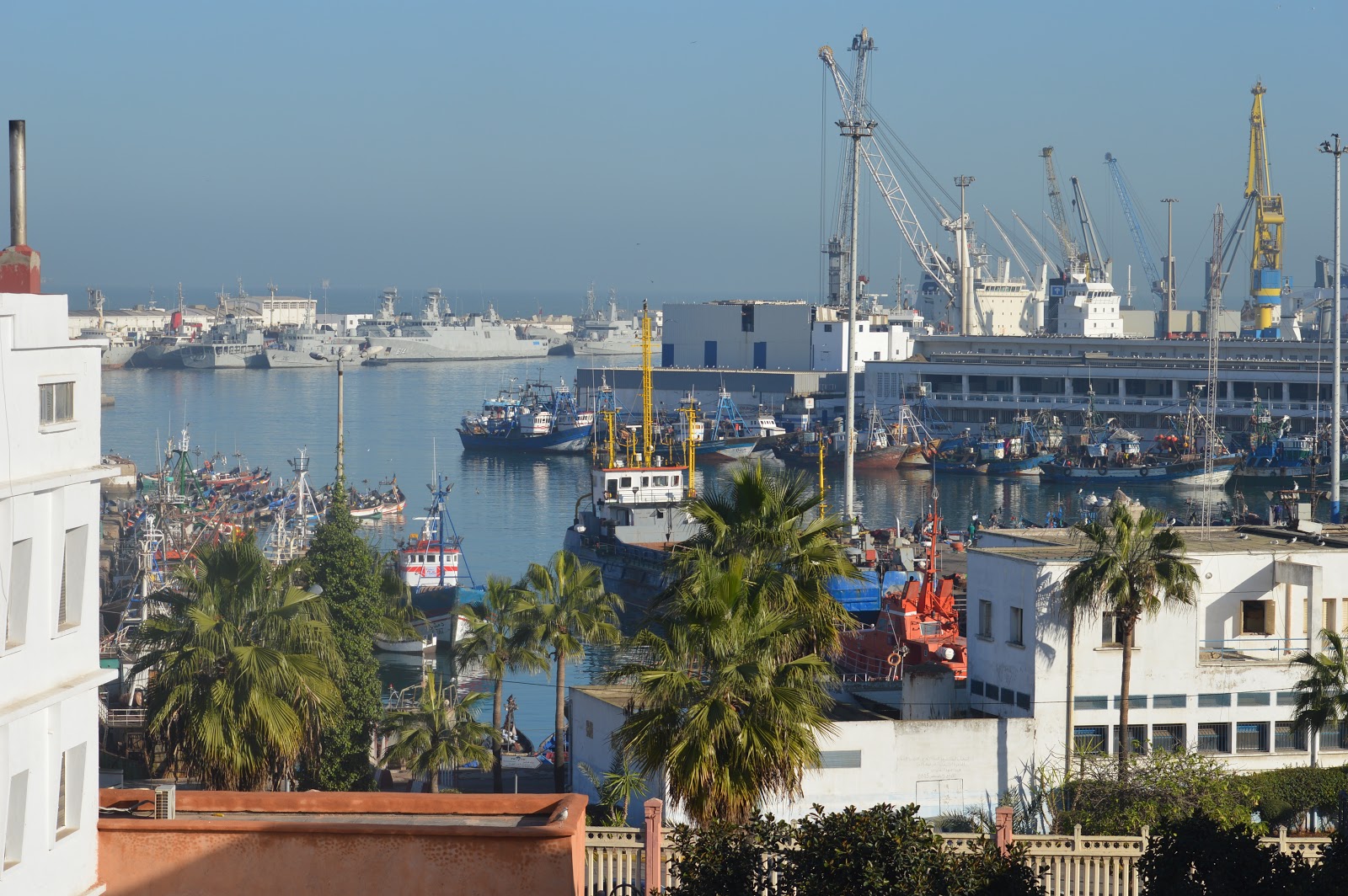
| Casablanca port |
Wednesday, 6 December 2017
Restaurant routièr
Continuing on the theme of cuisine bourgeoise ...
The one-sided sign faces east, so traffic on the D666 heading towards the A62 tollway might see it, then again, they might not. Traffic coming the other way will be none the wiser.
The sign carries the heading, Restaurant Traiteur, under which is written Cassany Remy and a phone number.
It sits opposite an open field and a farmhouse screened by large firs and a tall hedge. The restaurant itself is hidden behind a clump of trees, accessed by a pot-holed asphalt driveway. This leads to an expansive truck and car park. On this day, it contained quite a few vehicles.
But it didn't look like a restaurant. It looked like a house.
Although the place came highly recommended, I was struck by doubt and announced to our guests from London that I would not be held responsible for what might happen.
We walked in through the front door and saw a number of men seated at two long, narrow tables running the length of the facing wall.
There were smaller tables against the other wall and we were seated by a smiling, matronly woman wearing an apron. Most of the men followed us with expressionless stares. They made no response to my face-nodding "Bonjour". I got the impression we had entered a clubhouse ... without an invitation.
A platter of diced beetroot was already on the table. Our matronly waitress brought us a basket of bread and a cold, one-litre jug of house red.
The dining room was poorly lit and had a rather gloomy, nondescript decor.
The men at the long tables returned to their meals and conversation.
We helped ourselves from a metal tureen of soup, ladelling the steaming broth into our bowls. Before we could top up, the tureen was whisked away.
After soup, four serves of pork terrine in aspic were brought to the table. Each slice was topped with a small mound of shallot and vinegar reduction. The diced beetroot now came into play.
Once that was finished, we didn't have to wait long until a large oval dish was put in the centre of the table. This contained slices of roast pork loin in a thin sauce of its own juices. It was accompanied by a big dish of steaming haricot beans, thick and salty, mushy and yummy.
Next, a large bowl of dressed salad. Then, a not-too-shabby cheese platter with another basket of bread. Finally, a selection of supermarket desserts, such as chocolate mousse or sweet yogurt.
The coffee, served tar-black and bitter, was drunk from our wine glasses.
We asked the matronly woman about the restaurant. She said it was only open for lunch, Monday to Friday. She said it was family-owned and had been operating from this house for a very long time.
She gestured to the outside and said she could remember when the house was surrounded by farms and there was fresh produce right on their doorstep.
She said she was a close friend of the family and had worked for them for thirty years. The customers were truck drivers, tradesmen, workers and travelling salesmen. Some came back every day, she informed us proudly.
The cost of our home-cooked, delicious and very filling meal was 12 euros a head. We drank only a third of the wine.
Subscribe to:
Posts (Atom)